


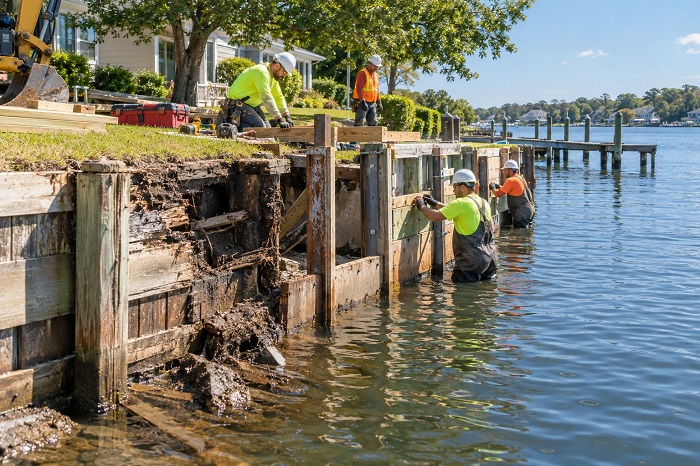
20 Nov Bulkhead repair scope: anchors, damaged sections, and what can be restored
Bulkhead repair is not limited to replacing a few boards or panels on the water side. Shore Protect Team describes repair as professional restoration of existing structures, including anchor replacement and repair of damaged sections. That creates a broader definition of repair that includes visible and structural components.
The company’s waterfront repair services cover bulkheads along with other marine structures, so an aging shoreline wall can be reviewed in the context of the surrounding property. Existing piers, docks, landscaping, and access can affect how repair work is reached even when those items are not being rebuilt.
The first repair question is which parts of the structure remain serviceable. A localized damaged section is different from a wall with widespread structural failure. The service page does not state that every damaged bulkhead can be repaired, so the condition assessment should define the limits of viable restoration.
Anchors deserve separate attention because Shore Protect Team specifically lists anchor replacement as a repair service. If the restraint system is part of the problem, restoring only the visible wall face would not describe the full scope.
Drainage may also need review where groundwater pressure acts behind the wall. Drainage and anchors solve different problems, but both can influence whether an existing wall continues to perform after visible repairs are completed.
The bulkhead repair options starts at $100 per linear foot, and the FAQ states that repairing an existing bulkhead typically costs 40-60 percent less than complete replacement. Those are useful references, but the actual savings depend on how much of the original structure can remain in service.
Repair should begin with component-by-component condition
An existing bulkhead can include wall panels or boards, piles, caps, anchors, drainage, and connections. Damage in one component does not automatically mean every component has failed. A repair assessment should identify which parts need restoration and which can remain.
This approach also prevents the opposite mistake: treating a cosmetic repair as sufficient when structural components are no longer reliable. The repair scope should match the actual condition rather than a predetermined budget target.
- Damaged wall sections – Areas that may be restored without replacing the full shoreline wall.
- Anchors – Components that may require replacement when the restraint system is no longer performing.
- Piles – Foundation elements that should be considered when movement or support issues are present.
- Drainage – A separate system used to manage groundwater pressure behind the wall.
- Access – The route required to reach the damaged section and structural components.
Why anchor repair is different from surface repair
A wall face can appear relatively intact even when the restraint system behind it has problems. Because tie-back anchors resist displacement under soil pressure, their condition can affect alignment and stability in ways that are not solved by replacing surface material.
The contractor should therefore explain whether the repair addresses the visible section, the anchors, or both. That distinction is especially important when comparing two proposals that use the same term “bulkhead repair.”
Repair cost depends on how much structure remains useful
The page’s 40-60 percent comparison between repair and full replacement gives owners a general reference, not a guarantee. Repair can be less expensive because serviceable portions of the existing structure remain, reducing the amount of new work.
If the damage extends across the foundation, anchors, drainage, or most of the wall length, the scope can move closer to replacement. The site assessment should determine that boundary before the owner relies on the percentage difference.
- Map the damaged sections by location and length.
- Review whether the visible wall damage is local or widespread.
- Check the anchoring system as a separate repair category.
- Consider drainage and groundwater conditions behind the wall.
- Review piles and support conditions where movement or settlement is present.
- Price repair only after identifying which existing components can remain.
What a clear repair proposal should say
A repair estimate should identify the exact sections being restored, the components being replaced, and the existing parts that are expected to remain. It should also explain whether anchor work, drainage work, or foundation work is included.
That level of detail makes repair proposals easier to compare with each other and with full replacement. The owner can see whether the lower price comes from preserving sound construction or simply from leaving important structural work outside the scope.
Repair boundaries should be visible in the written scope
A clear repair proposal should show where the work begins and ends. That can be described by footage, recognizable property features, or identified wall sections. The purpose is to prevent a disagreement later about whether an adjacent weak area was included in the quoted restoration.
The scope should also distinguish replacement of components from reinforcement of existing components. Replacing an anchor is different from adding support to a wall that remains in service. Restoring a damaged section is different from removing and rebuilding a continuous length. Those distinctions affect labor, material quantity, and how much of the original structure remains.
Owners can use this information to judge repair value more accurately. A lower repair price is meaningful when the scope clearly preserves sound components while correcting the damaged ones. It is less useful when the proposal simply omits structural items that another contractor has identified as necessary.
Photographs help define repair scope, but they do not replace site review
Photos can document leaning sections, damaged caps, exposed components, or localized deterioration, but they cannot confirm every hidden anchor, pile, or drainage condition. They are useful for organizing the first discussion while the final repair decision remains tied to a site assessment of the complete structure.
No Comments