


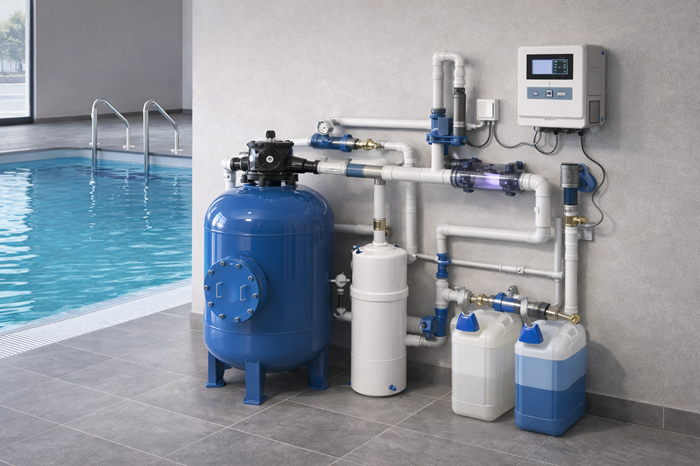
10 Apr Modern water purification technologies: membrane filtration methods and disinfection
Water quality today is determined not only by its natural source but also by the contaminants entering the system along the way to the consumer: from mechanical impurities and rust to organic matter, bacteria, microplastics, and traces of pharmaceuticals.
Therefore, modern water purification is built as a set of complementary technologies that are selected for specific tasks: drinking water, boiler water, industrial water, or swimming pool water.
An effective solution almost always involves a multi-stage system, where each stage removes its own class of contaminants and protects the next. The choice of equipment depends on the initial water analysis, required standards, performance, operating conditions, and budget, as well as the need for automation and minimization of reagent consumption.
Disinfection and integrated systems
UV treatment, ozonation, and reagent dosing
Modern disinfection is selected based on water type and the risk of secondary contamination:
- Ultraviolet – effective and chemical-free, but requires low turbidity and does not create a residual “protective” effect in pipes.
- Ozone – a strong oxidizer, reduces odors and organic matter, improves transparency; Requires proper degassing and safety monitoring.
- Chlorination/chlorine dioxide – provides residual action and is convenient for networks, but requires byproduct control and dosing.
For swimming pools and private facilities, a combination of mechanical filtration, sorption, and disinfection is often used. Niche queries related to pool and filtration circuit maintenance often include “pool cleaning miami,” but the principles for technology selection are the same: water analysis, circulation calculation, and parameter monitoring (pH, alkalinity, free chlorine/alternative disinfectants).
Examples of typical solutions for different tasks
- Apartment/house (drinking water): mechanical filter > carbon > reverse osmosis (with mineralization if needed) > UV (depending on risk).
- House with hard water: mechanical filter > softener > carbon (for taste) > fine filtration.
- Iron well: aeration/oxidation > iron removal filter > softener (if needed) > UV.
- Production: multi-stage pre-treatment > membranes > mineralization/conductivity adjustment > control Microbiology.
An optimal water purification system begins with laboratory analysis and goal setting: drinking water quality, equipment protection, or process water. After this, a combination of methods is selected, operating costs are assessed (cartridges, salt, reagents, backwash, energy), and automation and service are considered to ensure water quality remains stable not only at startup but also after years of operation.
Summary: How to quickly evaluate water and select a purification technology
The best results are achieved by combining: observable indicators (odor, color, sediment), field measurements (pH, TDS/conductivity, hardness, iron/manganese), and simple interpretive rules that directly link the indicators to the choice: filtration, sorption, iron removal, softening, membranes, disinfection.
A brief decision-making framework based on rapid test results
- Turbidity, suspended matter, rusty sediment > mechanical filtration (cartridges/disc/mesh), if necessary Pre-clarification/coagulation; then – target stages.
- Odor, taste, color (organics) > sorption on activated carbon; for high organic loads – combinations with membranes or oxidation (as indicated).
- Hardness (scale), high pH/carbonate content > softening (ion exchange) or membranes (reverse osmosis/nanofiltration) depending on the required quality and flow rate.
- Iron/manganese > aeration/oxidation + catalytic loading/filtration; for complex forms – enhanced oxidation circuits and contact tanks.
- High TDS/electrical conductivity (mineralization) > membrane technologies; Mineralization/flavor adjustment (postfiltration, mineralizer) for drinking water.
- Microbiological risk (well without sanitary zone, well, surface water, accidents) > mandatory disinfection (UV/chlorination) and barrier filtration; Confirm with analysis.
- Take baseline measurements on-site: pH, TDS/EC, hardness, iron (and manganese, if available), assess turbidity and odor.
- Compare goals: drinking water, household appliance protection, process needs – requirements will vary.
- Identify bottlenecks: what limits the choice (turbidity for membranes, iron for carbon, mineralization for softening, etc.).
- Create a preliminary scheme of 2-5 stages: prefilter > target treatment > finish (carbon/UV/membrane as required).
- Confirm the decision with a laboratory for critical parameters (microbiology, nitrates, heavy metals, organics) before final equipment selection.
No Comments